
انتشار مقاله عضو هیأت علمی گروه مهندسی مواد در حوزه مهندسی مواد، الکتروشیمی و تولید انرژی پاک
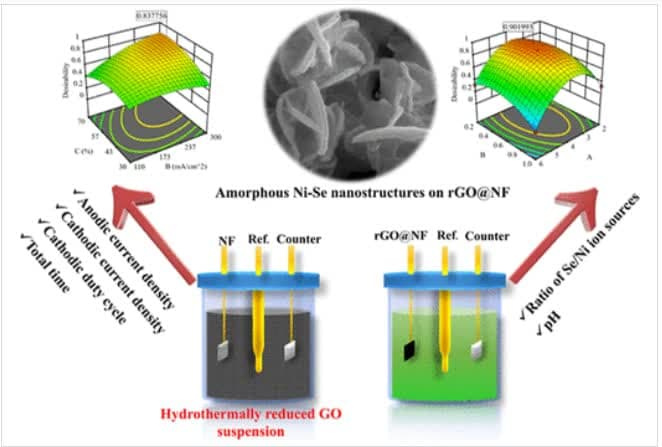
در این مقاله، بهینهسازی پالس الکترودیپوزیسیون معکوس گرافن اکسید کاهشیافته هیدروترمال (rGO) روی فوم نیکل (NF) با استفاده از روششناسی سطح پاسخ (RSM) انجام شد. همچنین، بهینهسازی pH و نسبت یونهای Se/Ni برای بهبود الکترولیت و رسوبگذاری Ni–Se روی الکترود rGO@NF انجام گردید. نتایج این مقاله نشان میدهد که الکترود بهینهشده Ni–Se@rGO@NF دارای ساختار نانویی با سطح تماس بالا و عملکرد الکتروشیمیایی برجسته در واکنشهای تجزیه آب است. علاوه بر این، این الکترود برای واکنشهای هیدروژنسازی، اکسیژنسازی و تجزیه آب دو عملکردی نیاز به ولتاژهای پایین دارد.
Title
Optimization of Pulse Electrodeposited Ni–Se Electrode Modified by Hydrothermally Reduced Graphene Oxide via Response Surface Methodology toward Developing Water-Splitting Electrode
Abstract
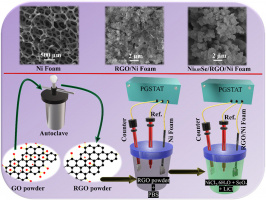
In this paper, the design of experiments (DOE) optimization was carried out via response surface methodology (RSM) based on central composite design (CCD) to investigate the impact of four main pulse reverse electrodeposition factors involved in the deposition of hydrothermally reduced graphene oxide (rGO) on nickel foam (NF). Furthermore, optimization with the same method was performed on pH and Se/Ni ion source ratio to achieve the best electrolyte for cathodic pulse electrodeposition of Ni–Se on the optimized rGO@NF electrode. Therefore, a high reduction degree of GO was achieved via hydrothermal reduction before electrodeposition, which was further enhanced by cathodic reverse pulses. RSM revealed desirable models for both processes. The X-ray diffraction (XRD) investigation indicated an amorphous Ni–Se structure, which holds many advantages for electrocatalytic activity. Moreover, the optimized Ni–Se@rGO@NF exhibited coin-like nanostructures on the field emission scanning electron microscopy (FESEM) images, providing a highly exposed surface area. As demonstrated in electrochemical investigations, the optimized Ni–Se@rGO@NF required 63, 185 mV, and 1.509 V to attain 10 mA·cm–2 for HER, OER, and bifunctional water splitting, respectively. Moreover, an excellent Cdl value of 106.55 mFsn–1/cm2 for the Ni–Se@rGO@NF suggested a high accessibility of the optimized electrode.
Keywords Design of experiments, Amorphous electrocatalyst, Large current water splitting, Hydrothermally rGO, Pulse reverse electrodeposition.
خاطر نشان میگردد این مقاله در آبانماه سال 1402 در ژورنال ACS Applied Energy Materials چاپ شده است.
شناسه DOI مقاله:
نظر شما :